Water tank
Municipal feed or stored water, sized for the route and refill plan.
A practical buying roadmap for a working drone washing kit. Choose the flight platform, then size the wash circuit and ground rig as one system.
SkyFlow × NECSS. SkyFlow scopes the aircraft and complete system; Niagara Exterior Cleaning Supply Store brings professional ground-washing equipment. Shop listed NECSS products through SkyFlow or plan a custom build together.
Buying the aircraft first is easy. The operating result depends on everything below it: power, water, pressure, hose, chemistry and a rig the crew can actually deploy.
The wash circuit is a chain. Each link must supply the next at the required flow and pressure.
Municipal feed or stored water, sized for the route and refill plan.
Separate DI/RO rinse production and controlled detergent delivery where needed.
Matched pump output, line diameter, reel and pressure-rated hose.
Nozzle, standoff and aircraft operating envelope validated at the surface.
Choose the dedicated HW150, a Matrice 400 with HW3 or HW3 Lite, or the available FC100 washing system. Each takes a different airborne tool and ground-pump pairing.
For Matrice 400, choose the aircraft, controller, batteries and charger, then the HW3 smart lance or HW3 Lite. Battery power keeps the aircraft setup simple; a tethered-power concept adds a ground station, power cable and site-power plan. A TK4 + wash-hose combination requires payload, connector and routing validation before ordering.
Choose the lance, nozzle, mounting hardware and hose as a set. HW3 adds smart wash modes; Lite is a simpler manual lance. HW150 uses a dedicated spray system. The FC100 washing system is available through SkyFlow; request its current package contents and pricing. Longer hose is not automatically greater cleaning height.
Match the ground pump to the washing system. Hose length, elevation, fittings and flow losses affect pressure at the nozzle.
| Washing system | Flow | Pressure | What to buy |
|---|---|---|---|
| Matrice 400 + HW3 / Lite | 3–5 GPM | 2,500–3,000 PSI | Choose a compatible pressure pump and hose; validate the final nozzle output for the surface. |
| HW150 | 4 GPM | 4,350 PSI rated; 5,075 PSI instant peak | Use the dedicated system specification. Do not treat peak pressure as the continuous pump setting. |
| FC100 washing system | 8–13 GPM ground-pump range | 4,000–5,000 PSI ground-pump range | Available through SkyFlow. Request the FC100 washing package and a matched pump, hose and ground rig. |
Matrice 400 and FC100 ground-pump ranges were provided by SkyFlow for this guide. HW150 values come from the HW150 technical guide. The ground-pump range is not an aircraft specification or a delivered-at-nozzle reading.
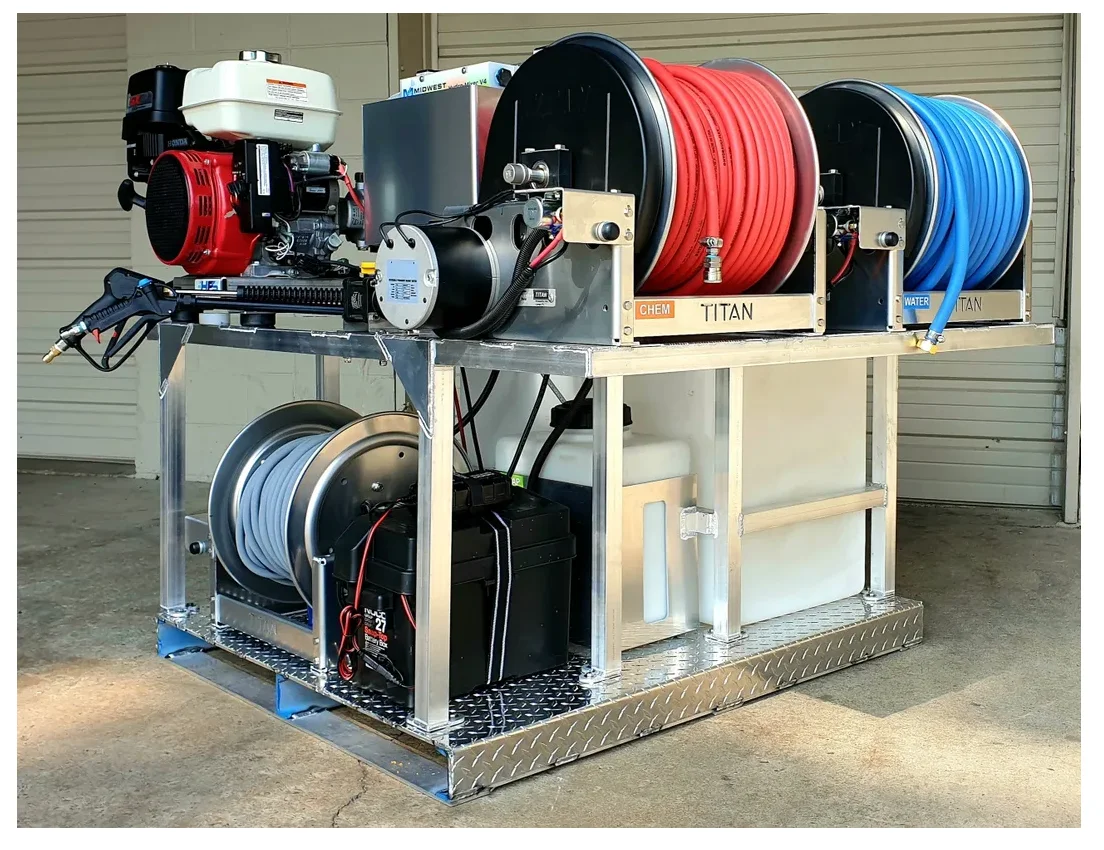
The ground rig is the operating room for the wash: water, power, pumps, storage, hose handling and service access. Size it to the day’s work and the vehicle’s payload.
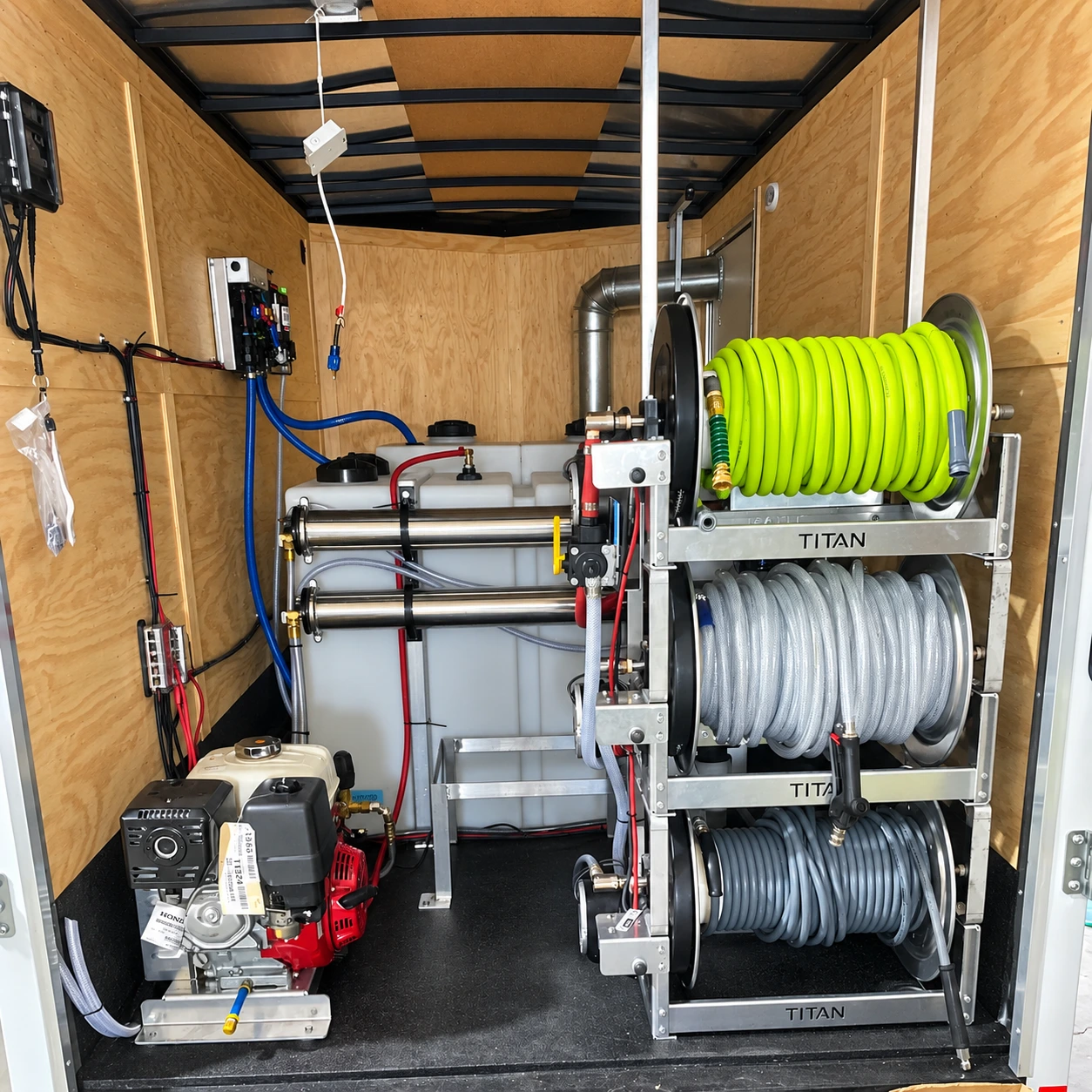
Choose electric when suitable site or generator power, duty cycle and protection are available. Choose gas for mobile, high-flow work where electrical capacity is limited; plan fuel, exhaust, noise and service access. Soft-wash demand pumps at 60–100 PSI are for a separate chemical circuit, not a substitute for the pressure pump.
Estimate water use from flow × active spray time, then add wash, rinse and refill allowance. At 5 GPM, 30 minutes of trigger time draws roughly 150 gallons before reserves. Water weighs about 8.34 lb per US gallon, so tank capacity changes vehicle payload quickly. For glass, specify DI or RO rinse-water treatment when the finish calls for it.
Choose chemical injection or proportioning for the soil and surface, with separate rinse and flush procedures. A heat box is an optional downstream heater for suitable pressure-washing circuits; do not assume it is part of SF13. Check its flow rating, power or fuel needs and temperature compatibility with hose, seals and aircraft tool.
SF13 is the compact smart drone-side pump, mixer and hose workflow for smaller jobs. A NECSS skid in a van or trailer adds room for tanks, filtration, hot water and conventional wand work. Verify loaded weight, ventilation, tie-downs, winterization and access for maintenance before committing to tank and equipment sizes.
The final kit should include the components, spares and field workflow that make a first job possible.
Aircraft, compatible wash mount, controller, batteries or tethered power, chargers, transport protection and spares.
Nozzles, pressure pump, filters, compatible hose and reel, water supply, backflow protection and tested fittings.
Vehicle and tank, chemistry, rinse-water plan, generator or fuel, hose management, test panel and maintenance plan.
Surface type, target height, hose route, water source, electrical service, vehicle capacity and weekly workload determine the useful configuration.
Yes. A lance positions and directs the spray; a compatible ground pump, water source and pressure-rated hose supply the wash. The selected product package determines what is included.
No. Suspended hose weight, friction losses, nozzle flow, wind, aircraft payload and site geometry determine the validated working envelope. Plan the entire path with SkyFlow.
No. A 60–100 PSI chemical or soft-wash demand pump is a different circuit from a thousands-of-PSI pressure-washing pump. Match each pump to the chemical, hose, nozzle and task.
Choose from the available site power, required flow and pressure, runtime, ventilation and service plan. Gas engines suit mobile high-flow work; electric systems can simplify operation when suitable power is available. Confirm the full pump curve and power source before buying.
Tell us which aircraft you own, the surfaces and heights you plan to clean, your water and electrical supply, and your vehicle. We can scope a matched aircraft, wash kit, pump, hose and ground rig.